
Temperature-Controlled Freight
Refrigerated and Temperature-Controlled Transport
We arrange, book and supervise refrigerated freight for commercial and industrial consignments across Syria, the UAE and Egypt, with the setpoint agreed in writing, the cold chain planned handover by handover, and the temperature record delivered with the cargo.
Reefer sea and roadCold chain planningTemperature records
MIDTRANS operations deskCold Chain Planning
Refrigerated and temperature-controlled transport

Reefer by sea
Marine reefer boxes on vessel power for the whole ocean leg.

Reefer by road
Genset and trailer units for door to door regional legs.

Temperature-controlled air
Thermal covers, active containers and cold rooms at handover.

Cold dock and stuffing
Pre-cooling, stuffing practice and consolidation handover points.




International Shipping & Customs Assistant
MIDTRANS Operations Desk
Team review before pricing or operations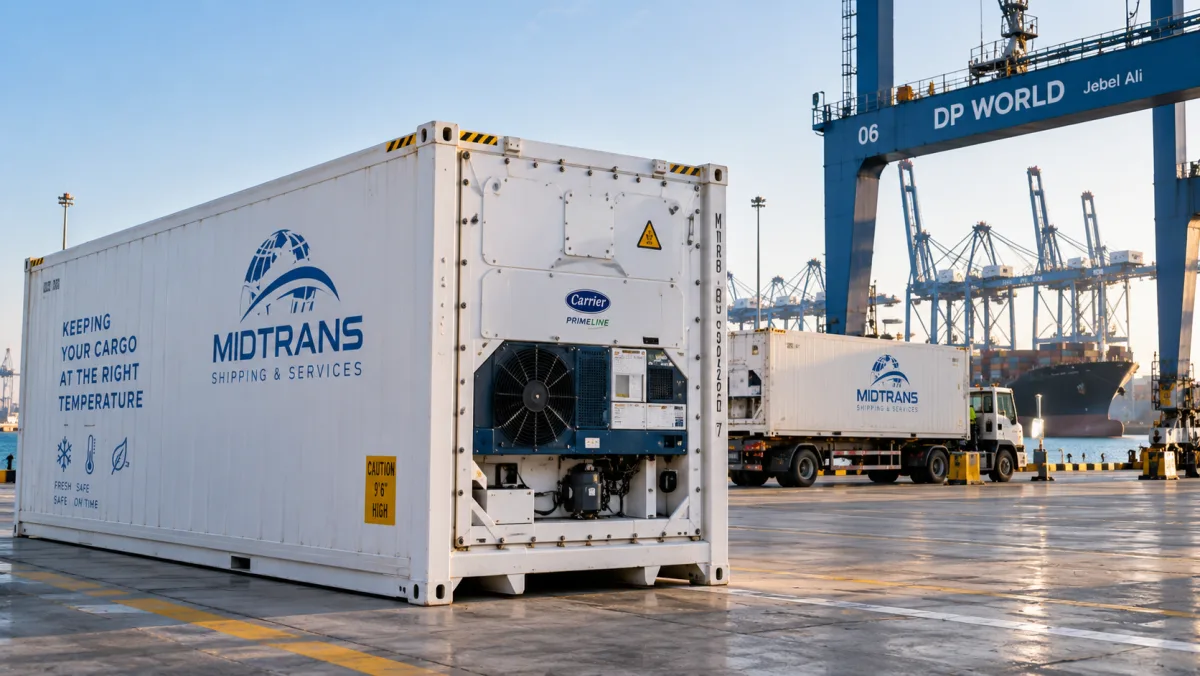
Overview
What refrigerated transport is
Refrigerated transport is the movement of cargo inside equipment that holds an agreed temperature from the moment the goods are loaded until they are delivered. In freight forwarding that equipment is called a reefer, short for refrigerated container, and the unbroken sequence of controlled steps around it is the cold chain. Midtrans Shipping And Services arranges, books, plans and supervises these movements for commercial and industrial consignments through appointed partners and licensed operators. We treat temperature as a routing constraint rather than a packing detail, because it decides the equipment, the gateway, the road leg and the documentary file all at once.
- Reefer equipment
- Agreed setpoint
- Cold chain continuity
- Temperature records
Reefer types
Reefer container types and what each one does
A reefer container is an insulated box with an integral refrigeration machine that draws power from the vessel, from a terminal plug-in point or from a road generator. The marine standards are the twenty-foot reefer and the forty-foot high-cube reefer, and the high cube carries most chilled and frozen ocean cargo because its internal height suits palletised loads. Controlled atmosphere units, in which the oxygen and carbon dioxide levels inside the box are actively adjusted, extend the storage life of respiring produce. Insulated passive boxes and refrigerated road trailers cover the legs that a marine box does not reach. We match the box type to the commodity, the leg structure and the loading point, and we confirm that choice in writing before the booking goes out.
- Twenty-foot reefer
- Forty-foot high-cube reefer
- Controlled atmosphere unit
- Insulated passive box
- Refrigerated road trailer
Setpoint
How the temperature setpoint is agreed and recorded
The setpoint is the single temperature value the reefer machine is instructed to hold, and it belongs to the shipper. We ask the shipper to declare the setpoint for the consignment together with the commodity and its packing, and we write that value onto the booking, onto the shipping instruction and onto the equipment interchange record. The machine is set to the declared value at stuffing and the value is read back at every handover. Frozen cargo, chilled cargo and pharmaceutical consignments each carry their own band, and we record the band the shipper states instead of applying a house default to cargo we did not produce.
- Setpoint declared by the shipper
- Setpoint on the booking
- Setpoint on the shipping instruction
- Setpoint read back at each handover
Pre-trip inspection
Pre-trip inspection before the box is released
A pre-trip inspection, abbreviated PTI, is the full functional test a depot runs on a reefer unit before it is released for loading. The compressor, the evaporator and condenser fans, the defrost cycle, the temperature sensors, the fresh-air vent and the data logger are each exercised and the result is written to a report. A unit that fails the test stays in the depot. We require the PTI report for every unit we book and we hand it to the shipper with the equipment release, because an inspection carried out after loading says nothing about the cargo already inside the box.
- Compressor and fan test
- Defrost cycle
- Sensor check
- Vent and air exchange
- Data logger started
Pre-cooling
Pre-cooling and stuffing practice
Pre-cooling means bringing the cargo down to its carriage temperature before it enters the container, since a reefer machine holds a temperature rather than pulling a warm load down to one. We plan the stuffing so that the doors stay open for the shortest time the operation allows, the box itself is pre-cooled where the commodity calls for it, and the load is stacked into the T-bar floor's air pattern instead of across it. Cartons stay below the red load line so return air reaches the evaporator, and the stow is braced so it holds position through the sea leg. Where the cargo is stuffed at a consolidation facility rather than at the factory, we arrange the cold dock and the handover point in advance, including at Jebel Ali and through our wider warehousing and consolidation desk.
- Cargo pre-cooled before stuffing
- T-bar floor airflow kept clear
- Load line respected
- Stow braced against shift
- Door-open time minimised
Ventilation & humidity
Ventilation and humidity for produce, frozen and pharmaceutical cargo
Ventilation and humidity settings differ by cargo family because the families have opposing needs. Respiring produce releases heat, carbon dioxide and ethylene, so the fresh-air vent is opened to exchange air with the outside and the humidity is held high enough to stop the goods drying out. Frozen cargo respires nothing, so the vent stays shut and the machine runs on full recirculation to protect the setpoint against outside air. Pharmaceutical and chemical consignments also run closed and are judged on the stability of the record rather than on air exchange. We take the vent position and the humidity target from the shipper alongside the setpoint and carry all three on one instruction.
- Fresh-air vent position
- Relative humidity target
- Ethylene sensitivity
- Recirculation for frozen loads
Cold-chain risks
Where the cold chain breaks
The cold chain breaks where the box changes hands or changes power source, not while the vessel is at sea. Four points carry that risk. Gate-out from the loading facility, where the unit runs on a generator or on nothing at all while the paperwork is completed. Terminal dwell, where the box waits for a free plug-in point on the reefer stack. The road leg, where the unit depends on a diesel generator set, abbreviated genset, clipped to the container frame. And transhipment, where the box is discharged, moved across a yard and re-plugged at a second port. We plan all four points explicitly, name the party who owns power at each one, and require the plug-in and unplug times to be recorded.
- Gate-out
- Terminal dwell and plug-in
- Genset on the road leg
- Transhipment and re-plug
Monitoring
Monitoring and temperature-record coordination
Every reefer movement produces a temperature record, and that record is the evidence the cold chain held. The integral machine logs supply air and return air temperatures at a fixed interval, the depot starts the logger at PTI, and the discharge terminal downloads it. For consignments that need evidence independent of the carrier's own equipment, we arrange a separate data logger placed with the cargo at stuffing and retrieved at delivery. We request the download at discharge as standard practice and issue it to the consignee with the arrival documents, so a temperature question is answered from a file instead of from recollection.
- Supply and return air log
- Independent cargo logger
- Download at discharge
- Record issued with arrival documents
Documentation
Documents that travel with temperature-sensitive cargo
Temperature-sensitive consignments carry the standard freight set plus the documents that describe the condition of the goods. The standard set is the commercial invoice, the packing list with the carriage temperature stated on it, and the bill of lading or air waybill endorsed with the setpoint. Foodstuffs of animal origin add a health certificate, plant produce adds a phytosanitary certificate, chemical consignments add a safety data sheet, and pharmaceutical consignments add the batch and expiry detail the destination authority calls for. We assemble this file with the shipper before the box is stuffed, because these certificates are issued against the goods as presented at loading. Our customs clearance desk and the Egypt clearance team work from the same file.
- Commercial invoice
- Packing list stating the carriage temperature
- Bill of lading or air waybill endorsed with the setpoint
- Health certificate for animal products
- Phytosanitary certificate for plant produce
- Safety data sheet for chemical cargo
Modes
Reefer by sea, reefer by road and temperature-controlled air
The three temperature-controlled modes differ in how the cold is powered and how long the cargo stays exposed. Reefer by sea freight plugs the container into the vessel supply for the whole ocean leg, which gives a steadier record and high volume per booking. Reefer by road freight runs on a genset or on a refrigerated trailer's own machine and moves door to door without a transhipment, which is why it carries the regional work between the UAE, Egypt and Syria, including the UAE to Egypt corridor. Temperature-controlled air freight gives the shortest elapsed time and is built from thermal covers, active containers and cold rooms at each airport handover, which makes the airport dwell the decisive part rather than the flight itself. We build the plan around the tolerance of the commodity and state which mode carries which leg.
- Sea leg on vessel power
- Road leg on genset or trailer unit
- Air leg with cold rooms at handover
- Mode stated leg by leg
Get started
What we need from the shipper to plan a temperature-controlled shipment
We plan a reefer movement from eight facts and we ask for all eight at the first enquiry: the commodity and its packing; the setpoint with the vent and humidity instruction; the origin and the delivery address; the pallet or carton count with gross weight and dimensions; the readiness date; whether the cargo is pre-cooled at the loading point; the certificates already held; and the party who receives the temperature record. With those eight in hand we book the equipment, arrange the PTI, plan the power at every handover and start the documentary file in parallel. Send them through the quote request or straight to operations.
- Commodity and packing
- Setpoint, vent and humidity instruction
- Origin and delivery address
- Pallet or carton count, weight and dimensions
- Readiness date
- Pre-cooling status at the loading point
- Certificates already held
- Recipient of the temperature record
Cargo types
The cargo we move under temperature control
We handle commercial and industrial temperature-sensitive cargo. That covers foodstuffs moving as trade consignments, pharmaceutical and healthcare products, chemical and laboratory materials, and industrial perishables such as adhesives, resins, coatings and cultures that hold a specification band. Each family arrives with its own documentary file and its own tolerance, so we plan each one against the commodity in front of us rather than against a standard reefer template.
- Commercial foodstuffs
- Pharmaceutical and healthcare products
- Chemical and laboratory materials
- Industrial perishables holding a specification band
FAQ
Frequently asked questions
Direct answers on reefer equipment, setpoints, cold chain handovers, records and documents.
What is a reefer container?
A reefer container is an insulated shipping container with an integral refrigeration machine that holds an agreed temperature using power from the vessel, from a terminal plug-in point or from a road generator set.
What is a pre-trip inspection?
A pre-trip inspection, abbreviated PTI, is the functional test a depot runs on a reefer unit before release, covering the compressor, the fans, the defrost cycle, the sensors, the fresh-air vent and the data logger. A unit that fails the test is not released for loading.
Who decides the temperature setpoint?
The shipper declares the setpoint for the consignment. MIDTRANS records that value on the booking, on the shipping instruction and on the equipment interchange record, and the value is read back at every handover.
Where does the cold chain break?
The cold chain breaks at gate-out from the loading facility, during terminal dwell before the box reaches a plug-in point, on the road leg where the unit runs on a diesel generator set, and at transhipment where the box is discharged and re-plugged at a second port.
What temperature-record coordination are provided?
The integral reefer machine logs supply air and return air temperatures and that log is downloaded at discharge. MIDTRANS also arranges an independent data logger with the cargo when the consignee needs evidence separate from the carrier equipment, and the record is issued with the arrival documents.
What documents accompany temperature-sensitive cargo?
The commercial invoice, a packing list stating the carriage temperature, and a bill of lading or air waybill endorsed with the setpoint. Foodstuffs of animal origin add a health certificate, plant produce adds a phytosanitary certificate, and chemical consignments add a safety data sheet.
Next step
Discuss a refrigerated shipment or a cold chain requirement
Share the commodity, the setpoint, the route, the documents and the timing once. Operations reviews the same structured request through WhatsApp, email or the contact desk.
Commodity, packing, setpoint, vent and humidity instruction.
Origin, delivery address, leg structure and the power source at each handover.
Certificates held, logger requirement and the party who receives the temperature record.


