
Warehousing and Consolidation Services
Warehousing and Consolidation Services
Warehousing and consolidation is the handling layer between a supplier gate and the transport that leaves with the cargo: goods are received, checked, held, grouped and rebuilt into the load that ships. We receive commercial and industrial consignments from several suppliers, tally and inspect them, hold them until the order is complete, and stuff them into one container or one trailer. This page explains the method behind that work. Our Jebel Ali facility and the way it runs are described on the Jebel Ali warehousing and consolidation page.
Cargo storageFreight consolidationDistribution planning
MIDTRANS operations deskShipment Information
Warehousing, cargo consolidation, packing and regional distribution coordination

Receiving and inspection
Piece tally against the packing list, marks read, cargo photographed, discrepancies noted before signing.
Storage types
Racked, block, open yard, temperature-controlled, segregated and bonded, each for a different cargo.
Consolidation and cross-stuffing
Buyer consolidation, load plans, container stuffing and direct box-to-box transfer without storage.

Jebel Ali facility
The Jebel Ali operation and its own procedures are described on a dedicated page.


International Shipping & Customs Assistant
MIDTRANS Operations Desk
Team review before pricing or operations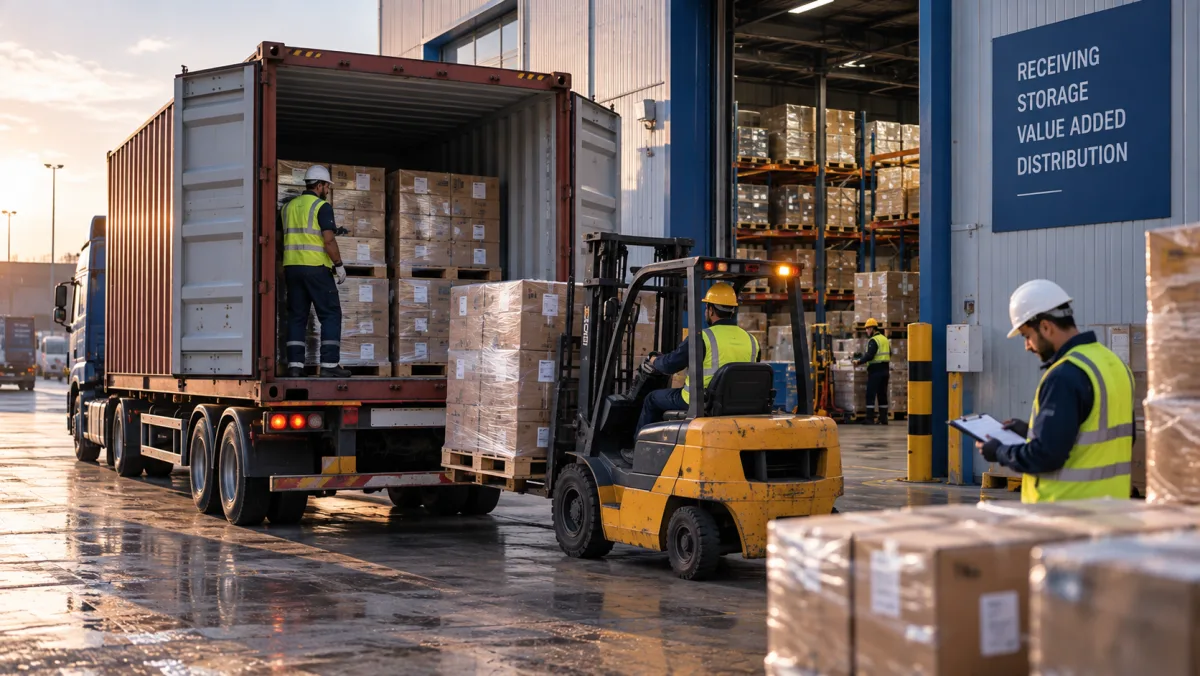
Overview
What warehousing and consolidation does
Warehousing and consolidation is the controlled receipt, holding and regrouping of cargo between the supplier gate and the transport that carries it onward. Consolidation is what makes it a freight service rather than storage: separate consignments become one shipment, one set of documents and one arrival.
We handle commercial and industrial cargo: raw materials, manufactured and finished goods, machinery and industrial equipment, spare parts, packaged production output, and project cargo staged before its onward movement.
- Controlled receipt against documents
- Holding until the order is complete
- Regrouping into one outbound load
- One shipment and one document set
- Commercial and industrial cargo only
Receiving
Receiving and inspection: what happens when cargo arrives
Every consignment is booked in against a document before anything is put away. We tally the pieces against the packing list, read the shipping marks and numbers on each carton and crate, weigh and measure whatever has not been declared, and photograph the cargo as it arrives.
Damage and shortage are recorded at that moment and at no other. A discrepancy noted before the delivery note is signed belongs to the supplier or the carrier; a discrepancy found after put-away belongs to whoever is holding the goods. We record the condition of the outer packing and note every wet, crushed, opened or re-taped package on the receiving report with the photographs attached.
Cargo that fails inspection goes to a marked quarantine area instead of into stock, so that it cannot be picked into an outbound load by mistake.
- Piece tally against the packing list
- Shipping marks and numbers verified
- Weight and dimensions captured on arrival
- Photographic record before put-away
- Damage noted before the delivery note is signed
- Failed cargo quarantined and marked
Storage types
Storage types and which cargo goes into each
Racked pallet storage holds uniform palletised cargo, each pallet in its own addressed location, so that a single pallet can be picked without moving anything else. Block or floor storage stacks heavy, oversized or unpalletised cargo directly on the floor: it costs less for each square metre and takes longer to pick out of. Open yard holds containers, steel, pipe, machinery and out-of-gauge pieces that need no roof over them.
Temperature-controlled rooms hold cargo with a declared range. Segregated and caged areas hold high-value and controlled cargo behind restricted access.
A bonded warehouse is customs-controlled premises where imported goods are held with duty and import tax suspended until the goods are entered for home use or re-exported. Duty-paid storage is the opposite: the goods have already been cleared and are in free circulation.
Storage is billed on the space occupied and the time it is occupied, and both are separate from the handling charged on the way in and the way out.
- Racked pallet storage for uniform loads
- Block and floor storage for heavy cargo
- Open yard for out-of-gauge pieces
- Temperature-controlled and segregated areas
- Bonded storage with duty suspended
- Space and time billed apart from handling
Consolidation
How consolidation and cross-stuffing actually work
Consolidation groups separate consignments into one outbound load so that the whole moves under one booking. A buyer consolidation collects from several suppliers against one purchase programme: each supplier delivers on its own date, the cargo waits until the order is complete, and the container is stuffed once.
Before anything is lifted we build a load plan from the piece list. Dense and heavy pieces go on the floor, lighter and crushable pieces above them, weight is spread so that the container or trailer stays inside its axle limits, and pieces that must not travel in contact are separated. The plan is what turns a yard full of pallets into a stuffed container that arrives intact.
Cross-stuffing is the direct transfer of cargo from one container or vehicle into another without putting it into storage in between. It is used when an inbound box has to be split between destinations, when the equipment changes because the onward leg runs on a different mode or a different trailer, and when several inbound loads are rebuilt into one outbound load.
Deconsolidation is the reverse: an inbound container is unstuffed, each consignment is separated against its own transport document, and each goes on to its own consignee or its own onward leg.
The work is recorded as it happens, with a piece count into the box, photographs of the load at each stage, and the container and seal numbers written onto the shipping documents.
- Buyer consolidation across several suppliers
- Load plan built from the piece list
- Weight spread inside the axle limits
- Cross-stuffing without intermediate storage
- Deconsolidation by transport document
- Piece counts, photographs and seal numbers recorded
Stock handling
Stock handling and value-added work
Cargo held in the warehouse is worked on rather than only stored. Each consignment carries its own reference, and stock is reported by reference, piece count and location so that the customer knows what is on the floor without asking for a count.
Repacking and re-palletising rebuild damaged or oversized pallets to the height and footprint the onward mode needs. Relabelling applies shipping marks, destination labels, handling symbols and case numbers. Pick and pack builds part-orders out of held stock against a dispatch instruction. Shrink-wrapping, strapping and corner protection go on before the load leaves.
Export packing crates, cradles and braces the pieces a carton will not protect. Wooden packaging used in international trade is heat-treated and marked under ISPM 15, the international standard for wood packaging material, and unmarked wood is refused at many borders.
Weighing and measuring produce the verified piece list that the onward booking is priced on.
- Stock reported by reference and location
- Repacking and re-palletising to the onward mode
- Relabelling, marking and case numbering
- Pick and pack against a dispatch instruction
- Export crating marked under ISPM 15
- Verified weights and dimensions produced
Onward flow
How the warehouse feeds the onward shipment
The warehouse produces the numbers the onward booking runs on. The verified piece list, gross weights and outside dimensions taken on our floor set the chargeable volume of a sea booking, the chargeable weight of an air booking and the loading metres of a road movement.
For a sea shipment the container is positioned at the door, stuffed against the load plan, sealed, and released to the terminal with the seal number on the documents. For a road movement the trailer is loaded in delivery order and the consignment note is signed at the gate. For an air shipment the pieces are palletised, weighed and measured for the air waybill and delivered to the airline terminal ahead of the acceptance cut-off.
Because the same team holds the cargo and books the transport, the piece list on the transport document is the piece list that left the floor.
- Verified piece list drives the booking
- Container stuffed and sealed at the door
- Trailer loaded in delivery order
- Air pieces measured for the waybill
- One piece list from floor to document
Locations
Where we hold and consolidate cargo
We hold and consolidate cargo in the United Arab Emirates and in Syria, and we work with contracted facilities elsewhere in the region for cargo that stages closer to its market.
Cargo staged in the UAE for onward carriage continues by sea, by road, or by a combination of the two, and the consolidation decides which. Grouping several small consignments into one full load replaces several small-shipment charges with one.
- United Arab Emirates and Syria operations
- Contracted facilities across the region
- Onward carriage by sea or by road
- Consolidation before the onward booking
- Staging close to the destination market
Get started
What we need to open a storage and consolidation file
Send the number of suppliers and their delivery dates, the commodity, the number and type of packages, the gross weight and outside dimensions, whether the cargo is stackable, any temperature or security requirement, the expected holding period, and the onward destination and mode. From that we assign the storage type, issue the receiving instruction to each supplier, and build the load plan.
- Supplier count and delivery dates
- Commodity, packages and gross weight
- Outside dimensions and stackability
- Temperature and security requirement
- Expected holding period
- Onward destination and mode
FAQ
Frequently asked questions
Answers on receiving, storage types, consolidation mechanics and export packing.
What is the difference between consolidation and cross-stuffing?
Consolidation groups separate consignments into one outbound load, normally after they have been received and held until the order is complete. Cross-stuffing is the direct transfer of cargo from one container or vehicle into another without putting it into storage in between, used when a box is split between destinations or when several inbound loads are rebuilt into one outbound load.
What is a bonded warehouse?
A bonded warehouse is customs-controlled premises where imported goods are held with duty and import tax suspended until the goods are entered for home use or re-exported. Duty-paid storage is the opposite: the goods have already been cleared and are in free circulation.
What is checked when cargo is received into the warehouse?
We tally the pieces against the packing list, read the shipping marks and numbers on each carton and crate, weigh and measure whatever has not been declared, photograph the cargo as it arrives, and record damage or shortage before the delivery note is signed.
What is a buyer consolidation?
A buyer consolidation collects cargo from several suppliers against one purchase programme. Each supplier delivers on its own date, the cargo is held until the order is complete, and the container is stuffed once, so the whole order moves under one booking and one set of documents.
Why does wooden export packing have to be marked?
Wooden packaging used in international trade is heat-treated and marked under ISPM 15, the international standard for wood packaging material. Unmarked wood is refused at many borders, so the crates, cradles and bracing we build for export carry the mark.
How does warehouse handling change the freight cost?
The verified piece list, gross weights and outside dimensions taken on the warehouse floor set the chargeable volume of a sea booking, the chargeable weight of an air booking and the loading metres of a road movement. Grouping several small consignments into one full load replaces several small-shipment charges with one.
Next step
Discuss a shipment, customs question, or logistics requirement
Send the supplier list and the onward destination and we return the storage type and the load plan.
How many suppliers deliver, on which dates, and what each one sends.
Packages, gross weight, outside dimensions, stackability and any controlled requirement.
Destination and mode, so the load plan is built for the transport that follows.


